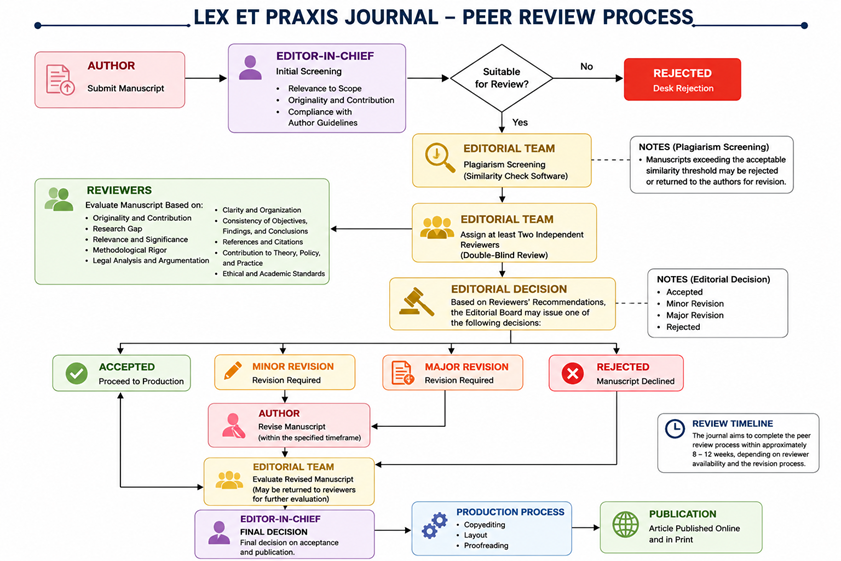
Peer Review Process
Lex et Praxis Journal implements a rigorous, fair, and transparent peer review process to ensure the quality, originality, and academic integrity of all published research.
1. Initial Editorial Screening
All submitted manuscripts are first evaluated by the editorial team to assess:
- Relevance to the journal’s scope
- Originality and scholarly contribution
- Compliance with the author guidelines
Manuscripts that do not meet these requirements may be rejected without proceeding to external review.
2. Plagiarism Screening
All manuscripts are screened using plagiarism detection software prior to the peer review process. Submissions exceeding the acceptable similarity threshold may be rejected or returned to the authors for revision.
3. Double-Blind Peer Review
Manuscripts that pass the initial screening are reviewed by at least two independent reviewers under a double-blind peer review system, in which both authors and reviewers remain anonymous throughout the review process.
4. Review Criteria
Reviewers evaluate manuscripts based on the following aspects:
- Originality and contribution to legal scholarship
- Identification and articulation of a clear research gap
- Relevance and significance of the research topic
- Methodological rigor and appropriateness of the research design
- Quality of legal analysis and argumentation
- Clarity, coherence, and organization of the manuscript
- Consistency between research objectives, findings, and conclusions
- Accuracy, adequacy, and currency of references and citations
- Contribution of the findings to legal theory, policy, and practice
- Compliance with ethical and academic publishing standards
5. Editorial Decision
Based on the reviewers’ recommendations, the editorial board may issue one of the following decisions:
- Accepted
- Minor Revision
- Major Revision
- Rejected
6. Revision Process
Authors are required to revise their manuscripts in accordance with the reviewers’ comments within the specified timeframe. Revised manuscripts may be returned to the reviewers for further evaluation when necessary.
7. Final Decision
The final decision regarding manuscript acceptance and publication is made by the Editor-in-Chief.
8. Review Timeline
The journal aims to complete the peer review process within approximately 8–12 weeks, depending on reviewer availability and the revision process.